GaitAI OrthoMotion
Measure how joints, limbs and posture affect walking.
OrthoMotion evaluates movement changes associated with orthopedic, musculoskeletal and post-surgical mobility — knee and hip recovery, foot and ankle mobility, spine and posture, limp assessment and post-surgical gait monitoring.
Problem
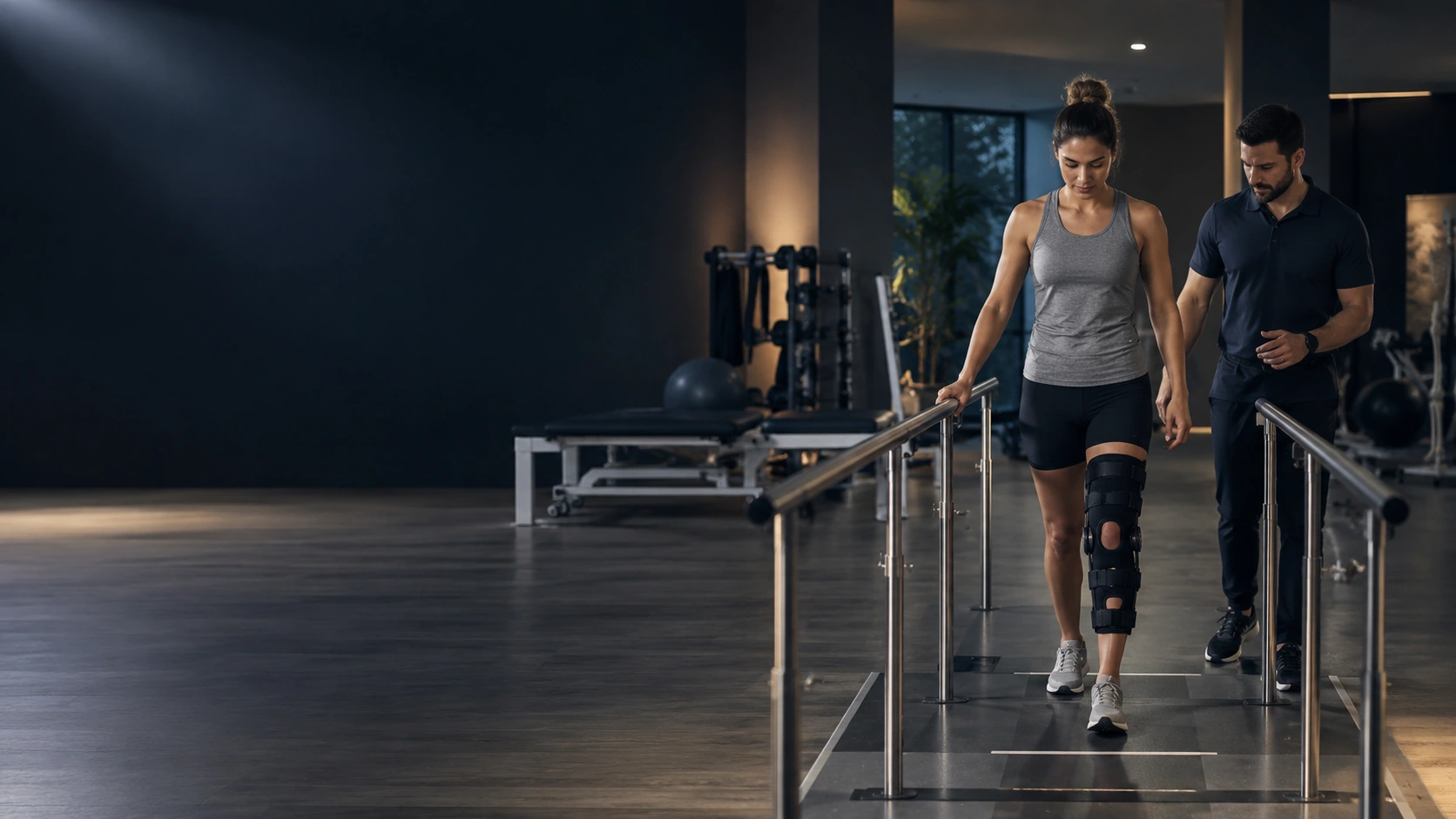
Orthopedic recovery is often judged from visual gait checks and patient-reported comfort, which makes small residual limps and loading asymmetries easy to miss.
What GaitAI does
Walking assessments are converted into limp, loading and posture indicators that can be compared before and after surgery or across recovery.
Who uses it
- Orthopedic surgeons
- Physiotherapists
- Sports-medicine teams
- Rehabilitation centres
- Post-surgical follow-up clinics
What they receive
Example report values — illustrative, not measured performance claims.
Indicators quantify how the operated or affected side is being used during walking. They support recovery monitoring and follow-up planning; they are not a diagnostic measurement of joint health.
Why it matters
Adds quantitative movement evidence to orthopedic recovery monitoring — residual asymmetry stays visible until it is actually resolved.
Example workflow
- 01Capture a pre-op or baseline walk where possible
- 02Repeat short assessments across recovery
- 03AI compares limp, loading and posture indicators
- 04Ortho team reviews the recovery trend
- 05Follow-up focuses on unresolved indicators
Deployment
- Corridor or clinic capture with existing devices
- Pre-op / post-op comparison workflow
- Works alongside RehabTrack during therapy blocks
- PDF recovery evidence for surgical follow-up
Research basis
Published work is the research foundation for the capabilities this product is built on. That record covers the movement-analysis methods themselves — it is not a validation of this product's outputs, and there is no clinical validation study, accuracy benchmark or trial result behind them.
- Pose estimation
- Pose-based gait analysis
- Gait analysis
- Gait recognition & biometrics · Pose-based gait analysis
- Advancements in Artificial Intelligence for Biometrics: A Deep Dive into Model-based Gait Recognition TechniquesEngineering Applications of Artificial Intelligence · 2024
- Journey into Gait Biometrics: Integrating Deep Learning for Enhanced Pattern RecognitionDigital Signal Processing · 2024
- Deep learning pipelines for recognition of gait biometrics with covariates: a comprehensive reviewArtificial Intelligence Review · 2023
- Data Preprocessing and Feature Selection Techniques in Gait Recognition: A Comparative Study of Machine Learning and Deep Learning ApproachesPattern Recognition Letters · 2023
- A robust covariate-invariant gait recognition based on pose featuresIET Biometrics · 2022
- Intra-class variations with deep learning-based gait analysis: A comprehensive survey of covariates and methodsNeurocomputing · 2022
Evidence status
GaitAI Evidence Index
3 categories documented
What is documented for this module, and what is not. Research foundation is not product validation — the two are listed separately on purpose.
- Research foundationAvailable
- 1 published record directly addresses a capability this module is built on (Pose-based gait analysis).
View evidence for Research foundation
Claim / capability: 1 published record directly addresses a capability this module is built on (Pose-based gait analysis).
Status: Available
Applicability: The cited work is specifically about a method or movement signal this module draws on.
Limitation: Research relevance is not evidence that this product's outputs have been validated.
- publicationA robust covariate-invariant gait recognition based on pose features · IET Biometrics, 2022
Inventory reviewed .
- Architectural research relationshipAvailable
- 5 published records inform shared platform capabilities this module uses (Gait recognition & biometrics). The research does not address this module's application specifically.
View evidence for Architectural research relationship
Claim / capability: 5 published records inform shared platform capabilities this module uses (Gait recognition & biometrics). The research does not address this module's application specifically.
Status: Available
Applicability: Shared capabilities such as pose estimation or temporal modelling are used by many modules.
Limitation: A shared-platform relationship is the weakest research link and must not be read as validating this module.
- publicationAdvancements in Artificial Intelligence for Biometrics: A Deep Dive into Model-based Gait Recognition Techniques · Engineering Applications of Artificial Intelligence, 2024
- publicationJourney into Gait Biometrics: Integrating Deep Learning for Enhanced Pattern Recognition · Digital Signal Processing, 2024
- publicationDeep learning pipelines for recognition of gait biometrics with covariates: a comprehensive review · Artificial Intelligence Review, 2023
- publicationData Preprocessing and Feature Selection Techniques in Gait Recognition: A Comparative Study of Machine Learning and Deep Learning Approaches · Pattern Recognition Letters, 2023
- publicationIntra-class variations with deep learning-based gait analysis: A comprehensive survey of covariates and methods · Neurocomputing, 2022
Inventory reviewed .
- Product specificationAvailable
- The module has a documented specification: inputs, pipeline, outputs and stated limitations.
View evidence for Product specification
Claim / capability: The module has a documented specification: inputs, pipeline, outputs and stated limitations.
Status: Available
Applicability: Documented inputs, intended workflow and output design.
Limitation: Documentation does not establish a released implementation or deployment readiness.
- specificationProduct documentation
Inventory reviewed .
- Product implementation evidenceNot yet published
- No module-specific release or deployment record is published here.
View evidence for Product implementation evidence
Claim / capability: No module-specific release or deployment record is published here.
Status: Not yet published
Applicability: Production implementation is distinct from this website's interactive prototypes.
Limitation: The browser pose explorer is not the full clinical or operational product pipeline.
- Context · not validation evidenceProduct and deployment context
Inventory reviewed .
- Interactive demoNot yet published
- No sample output has been built for this module yet.
View evidence for Interactive demo
Claim / capability: No sample output has been built for this module yet.
Status: Not yet published
Applicability: An interactive explanation of the intended output and workflow.
Limitation: Sample outputs contain illustrative values and are not measurements of a visitor or product performance.
No supporting source is published for this status.
Inventory reviewed .
- Benchmark validationNot yet published
- Validation pending publication. No product benchmark numbers are supplied.
View evidence for Benchmark validation
Claim / capability: Validation pending publication. No product benchmark numbers are supplied.
Status: Not yet published
Applicability: A benchmark needs a defined dataset, sample count, environment, hardware and evaluation method.
Limitation: Accuracy, sensitivity, specificity, latency and FPS cannot be inferred from a demonstration.
- Context · not validation evidenceResearch evidence inventory
Inventory reviewed .
- Product-specific validationNot yet published
- No study in the published record evaluates this module's output for a particular intended use.
View evidence for Product-specific validation
Claim / capability: No study in the published record evaluates this module's output for a particular intended use.
Status: Not yet published
Applicability: Validation must match the module, population and intended decision.
Limitation: A product description or related research paper does not establish validated performance.
- Context · not validation evidencePublished evidence inventory
Inventory reviewed .
- Pilot & deployment evidenceNot yet published
- No named pilot, deployment result or customer outcome is documented.
View evidence for Pilot & deployment evidence
Claim / capability: No named pilot, deployment result or customer outcome is documented.
Status: Not yet published
Applicability: Pilot and deployment evidence is assessed separately from research.
Limitation: Use-case journeys describe intended workflows, not customer results.
- Context · not validation evidenceTrust Center
Inventory reviewed .
- Product-specific clinical validationNot yet published
- No product-specific clinical validation study is published in this library.
View evidence for Product-specific clinical validation
Claim / capability: No product-specific clinical validation study is published in this library.
Status: Not yet published
Applicability: Clinical applicability depends on the intended use; safety modules are not presented as clinical tools.
Limitation: No output replaces clinician judgement or establishes a diagnosis.
- Context · not validation evidenceResponsible use and intended context
Inventory reviewed .
- Regulatory clearanceNot claimed
- No medical-device clearance, regulatory approval or compliance status is claimed.
View evidence for Regulatory clearance
Claim / capability: No medical-device clearance, regulatory approval or compliance status is claimed.
Status: Not claimed
Applicability: Regulatory applicability depends on the intended use and deployment jurisdiction.
Limitation: Research publications, patents and prototypes are not regulatory clearances.
- Context · not validation evidenceWhat GaitAI does not claim
Inventory reviewed .
Inventory reviewed How GaitAI states evidence →
Privacy & responsible use
Designed to support consent-based capture, encrypted transfer, configurable retention and role-based access, with activity logging and skeleton-only processing modes. Deployment requirements depend on the applicable environment, organization and jurisdiction. Privacy-aware architecture does not automatically mean anonymity: pose, gait and trajectories may still carry identifying information. GaitAI outputs are AI-generated movement metrics intended as decision support — they do not diagnose medical conditions and do not replace clinical judgement.
Context & limitations
- Video-based proxies do not measure internal joint forces
- Loading indicators are movement-derived proxies, not force-plate measurements
- Outputs support recovery monitoring, not diagnosis of joint pathology
Related MobilityCare products
All products
Turn a walking video into a clinician-ready movement report.
Analyzes a short walking video and turns it into gait and mobility metrics — ready as a downloadable PDF.

Show objective movement change across recovery.
Compares movement across therapy sessions to make rehabilitation progress visible and motivating for both clinician and patient.
How well does the device walk?
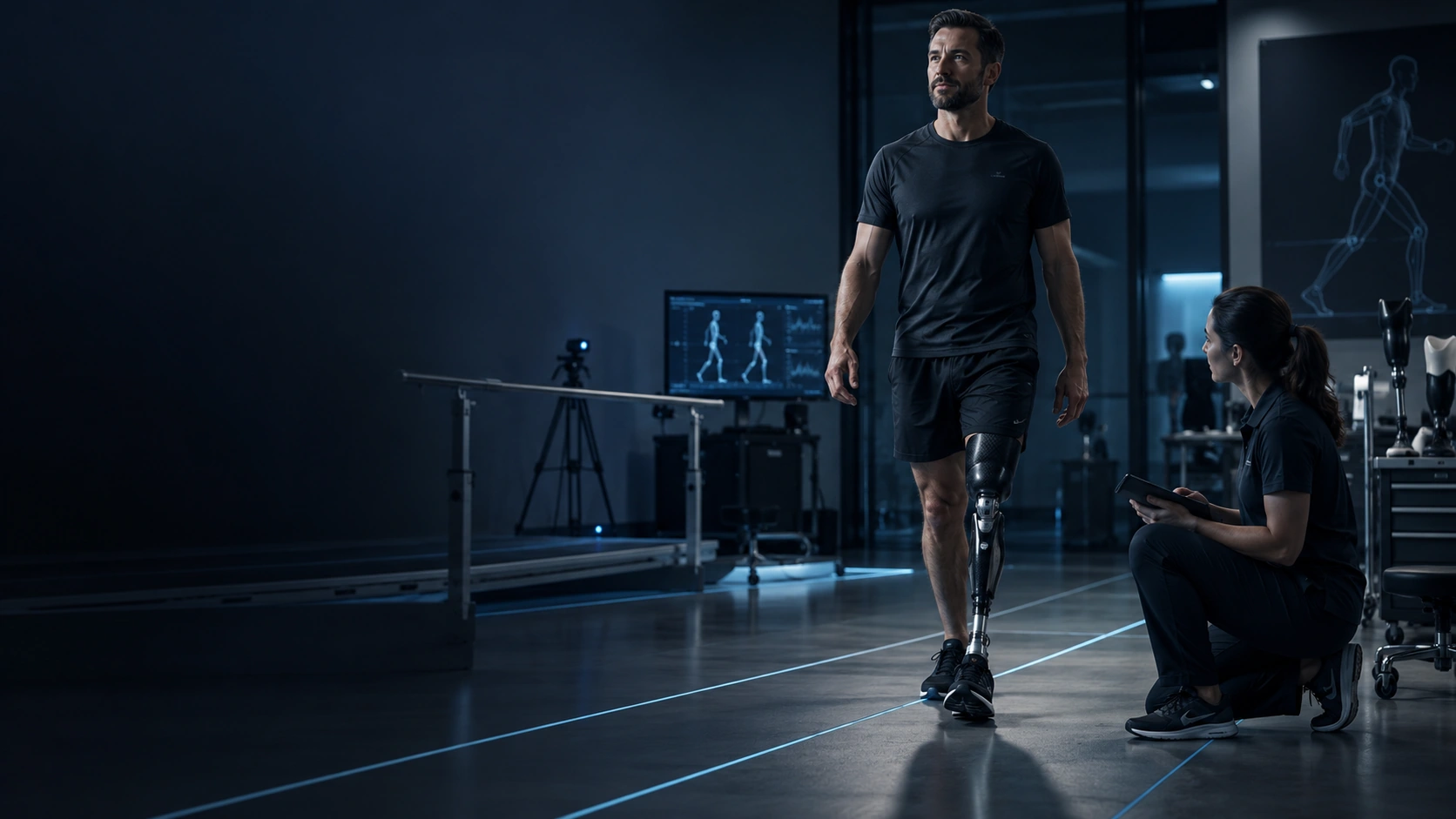
Quantifies movement changes associated with prosthetic or orthotic use — symmetry, cadence, gait timing, posture and loading proxies, compared before and after a fitting change.